This would not be an autistic website without a dinosaur page.
Ornithischian Dinosaurs

Heterodontosaurus
Time period: Early Jurassic
Location found in: South Africa
This fella is my personal favorite dinosaur. Heterodontosaurus is the namesake of the family Heterodontosauridae, which contains many different genuses. Its name literally means 'different-toothed lizard', and it was given this name due to the varied nature of its teeth. A number of reptiles, dead and alive, only have one type of teeth in their mouth. However, Heterodontosaurus had small incisors in the front, a pair of tusks in each jaw, and molars in the back. It is suspected to be herbivorous or omnivorous, using its tusks for either chewing tough plant matter or killing prey. Because another heterodontosaurid, Tianyulong, was found with integument indicating quills, Heterodontosaurus is theorized to have quills too.

Minmi
Time period: Early Cretaceous
Location found in: Australia
I remember owning a dinosaur encyclopedia with this guy in it, written at the time that Minmi was the shortest genus name of any dinosaur. We've got Anzu and Maip now, so let's focus on Minmi for how it lived and not what its name was! Minmi Paravertabra was first discovered in 1964, near Minmi Crossing in Queensland, Australia. It was a small ankylosaur, with unique bone structures along the sides of its vertebrae (hence the species name Paravertebra). These structures are similar in shape to the structures found in alligator vertebrae, which are used for muscle attachment, making alligators able to run stupidly fast for an ambush hunter.
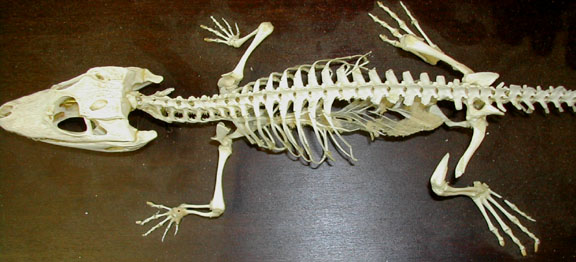
(Pictured above: an alligator skeleton, because most of the Minmi images online are paleoart reconstructions)
anyways. Because of this, Minmi is theorized to have been a fast runner. This would've made Minmi able to run from predators as well as having protective ankylosaur plating.
Saurischian Dinosaurs
%3Amax_bytes(150000)%3Astrip_icc()%2Feuropasaurus-56a254475f9b58b7d0c91b98.png&f=1&nofb=1&ipt=15c329143dd7d5c6f7df1c17e11a4231089f9e89827b2b521df462d0825d38c4)
Europasaurus
Time period: Late Jurassic
Location found in: Northern Germany
Non-Dinosaurs (Pre-Mesozoic)
Opabinia Regalis
Time period: Middle Cambrian
Location found in: British Columbia
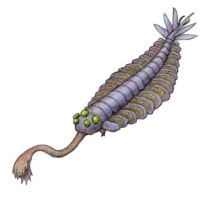
Opabinia is a mystery. All we really know is that it was a sort of aquatic arthropod now lost to time. It has five eyes, and is believed to have used its clawed proboscis to bring food to its mouth. It was first found in the famous Burgess Shale, and all known specimens thus far have been found there.
I was once lucky enough to take a trip to see the holotype specimen located at the Smithsonian museum in Washington DC. There it was. on display. the beloved opabinia, crushed under sediment and fossilized. it was small enough to fit in my hands, and possibly wiggle around in them. it was a really spiritual experience, i dare say... getting to see a thing that lived so many millions of years ago and still being able to vividly imagine it undulating through the ancient waters it called home. i dunno man. fossils do something to me.
Tiktaalik
Time period: Late Devonian
Location found in: Northern Canada
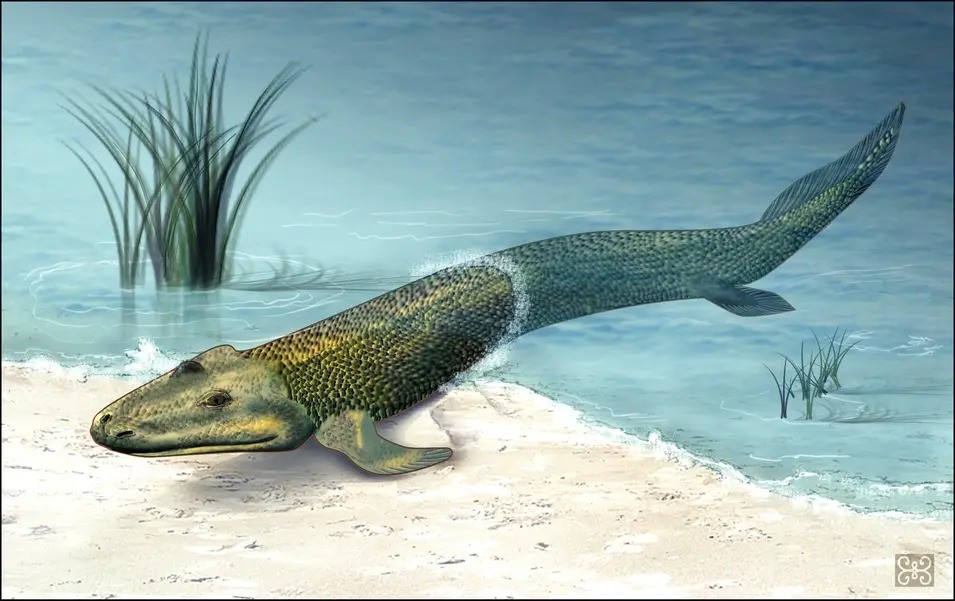
You know it. You love it. Evolution deniers chide it. It's Tiktaalik! Tiktaalik was a sarcopterygian (lobe-finned) fish, like modern lungfish and coelocanths. With basic wrists bones and fingerlike fin rays, it was likely able to crawl around in shallow waters, and maybe even on land for short periods of time. Contrary to popular belief, Tiktaalik isn't a concrete 'missing link' between fish and tetrapods (land-living vertebrates). This fellow is, unfortunately, not our grandpa. However, Tiktaalik's biology is indicative of adaptations that would facilitate the gradual development of land-dwelling vertebrates.
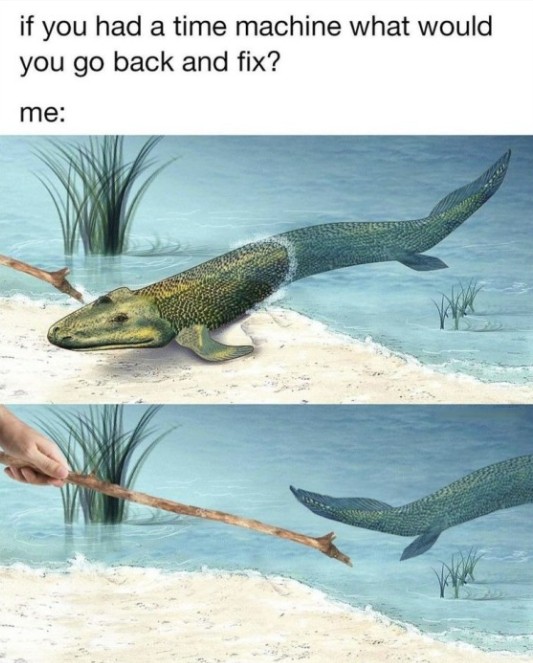
so yeah. pushing Tiktaalik back into the ocean probably would not have prevented you from wasting your time on this webpage 375 million years later. we like it though. we all like the Tiktaalik :3